
About Our Passive House Standard Homes

SEG ENERGY LEASING LIMITED develops and delivers next-generation private residential housing projects designed and constructed in full compliance with the international Passive House standard. Our homes are focused on extremely low energy consumption, a high level of living comfort, and long-term operational reliability.
The structural core of our buildings is based on SIP panels with cement-bonded particle boards (CBPB) and graphite-enhanced XPS insulation, providing:
-
excellent thermal insulation and the elimination of thermal bridges;
-
outstanding airtightness (n50 ≤ 0.6 h⁻¹);
-
non-combustible external envelope construction;
-
high resistance to moisture, frost, and demanding climatic conditions.
The houses are designed according to a modular “transformer house” concept, allowing the floor area to be expanded step by step without compromising thermal performance and without excessive upfront construction costs.
Our Projects are targeted at the EU and Caucasus markets and rely on materials fully compliant with EN standards, CE marking, and Passive House requirements, making the quality of SIP panels a critical component of the entire building system.

We install, Free of charge, a solar power system and a 22 kW MIDA (China) home charging station under a roof lease agreement of 15 years or more. This allows you to sell surplus energy back to us and receive cashback when charging your electric vehicle at GDB Green Energy Village homes or at Passive House–standard homes built on your own land under our Projects.

Panoramic Architecture and Precision Engineering at GDB Green Energy Village
In the homes of GDB Green Energy Village, the windows and doors are truly conceptual — stretching from floor to ceiling and visually expanding the living space.
Our equipment is supplied by companies from Poland, Latvia, Turkey, and China, all selected through a competitive process. These manufacturers produce the core components of their systems in-house, ensuring exceptional quality and technological consistency.


What is a Passive House?
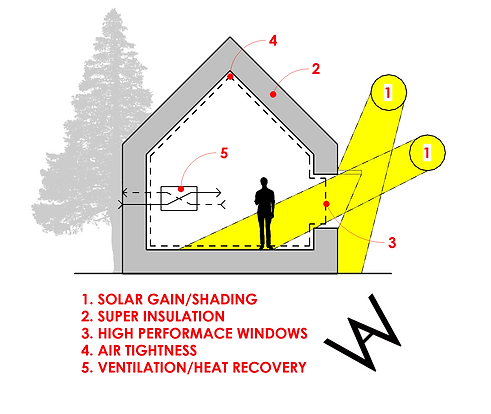
A Passive House is a modern, highly energy-efficient home that uses several times less energy than conventional buildings. Its main feature is the ability to retain warmth in winter and stay cool in summer, almost without the need for traditional heating and air-conditioning systems. These homes are built in accordance with the international Passive House standard, which is based on three key principles:
-
ultra-high-performance insulation of walls, floors and roofs
-
airtight building envelope
-
mechanical ventilation system with heat recovery
As a result, a Passive House uses up to 90% less energy for heating compared to standard buildings. Inside, a comfortable temperature, clean fresh air and a stable indoor climate are maintained all year round.
Why a Passive House Home is Superior to a Regular House?
SIP panels based on cement-bonded particle boards (CBPB) and XPS insulation (with or without graphite) represent a modern and reliable structural system for energy-efficient homes. The CBPB provides strength, moisture resistance, fire resistance and long-term structural stability, while the XPS delivers excellent thermal insulation performance and durability. The use of graphite-enhanced XPS further reduces heat loss thanks to its improved thermal conductivity. Manufacturer's warehouse price: USD 50/ m2 (price in your home).
Unlike standard windows, Passive House–certified wood–aluminium windows feature multi-chamber frames, advanced thermal breaks and triple glazing filled with inert gas. The glazing is coated with low-emissivity layers that reduce heat loss in winter while limiting solar overheating in summer. As a result, these windows achieve extremely low U-values, ensuring minimal thermal bridging and outstanding energy performance. Manufacturer's warehouse price: See information below.
Trickle vents in Passive House buildings are used in a very different way than in conventional housing and are often misunderstood. In classic construction, trickle vents are small background ventilators installed in window frames to allow uncontrolled airflow. In Passive House design, however, the priority is fully controlled ventilation. Manufacturer's warehouse price: See information below.
Passive House entrance doors are equipped with multiple sealing gaskets and are installed within the warm zone of the opening, with continuous connection to the wall’s vapour and wind protection layers. This prevents draughts, heat loss, and condensation even in cold climates. A key parameter is a low thermal transmittance (U‑value) — typically no higher than 0.8 W/m²K for the entire door unit. This is achieved through a multi-layer door construction, an insulated core, thermal breaks in the frame, and high-quality seals around the entire perimeter of the door. Manufacturer's warehouse price: See information below.
Renewable Energy Systems: In Passive House buildings, renewable energy systems play a crucial role in maximising energy efficiency, reducing utility costs, and supporting a sustainable lifestyle. These systems allow homes to generate, store, and utilise clean energy, often exceeding the building’s own consumption needs. Manufacturer's warehouse price: USD 900/ kW, if your home is not participating in the GDB Green Energy Village project and Programme.

Passive House Home, Even in Cold Weather...
Change the way you think about a home when it’s built to Passive House standards!
Question: Are underfloor heating and radiators necessary when it’s −10 °C outside?

Answer: Not necessarily. In the Passive House standard, conventional heating is replaced by the following technologies:
-
High levels of insulation in walls, roof, and floor (extremely low U-values).
-
Completely airtight construction, minimising heat loss through gaps and cracks.
-
Energy-efficient windows with triple glazing and low-emissivity coatings.
-
Mechanical ventilation with heat recovery (MVHR), which warms incoming fresh air using the heat from air leaving the house.
Thanks to these features, a comfortable indoor temperature is maintained without powerful radiators or underfloor heating.
Question: Are electric underfloor heating systems necessary in a Passive House?
Answer: It’s better to choose a water-based underfloor heating system! These systems work by circulating a controlled flow of warm water through pipes embedded beneath the floor, whether it’s wood or tile.
This allows the system to heat the entire room evenly, which is more efficient than traditional radiators, where heat can be lost as it rises in just one area. Low outdoor temperatures also pair perfectly with renewable energy sources, such as heat pumps. It is usually around 10–20% more efficient than radiators. The cost of installing a water-based underfloor heating system ‘turnkey’ (including materials, pipes, manifolds, labour, and all associated expenses) is USD 100 per m².


It is important to understand that an energy-efficient home is not simply an “airtight box.” A house must be “breathable,” meaning it should have controlled air exchange through a mechanical supply and extract ventilation system with heat recovery. This approach ensures a healthy indoor climate, optimal humidity levels, and a constant supply of fresh air without energy loss.
A Passive House is not just a well-insulated or airtight building. Unlike ordinary homes, it is a carefully engineered system that combines high-quality insulation, airtight construction, advanced windows, and high-performance doors to maintain comfort throughout the year.
1. No Need for Constant Heating
In winter, a Passive House retains heat extremely efficiently, meaning you do not need to constantly heat your home. The internal temperature remains comfortable even during the coldest months, drastically reducing energy consumption and heating bills.
2. No Need for Air Conditioning in Summer
During hot summer months, a Passive House stays cool without requiring active air conditioning. Its insulation and airtight design, combined with shading and ventilation strategies, prevent overheating and reduce electricity usage.
3. Advanced Window Technology
Passive House windows feature special triple-glazed units with inert gas fill and low-emissivity coatings. These glass units:
-
Minimise heat loss in winter
-
Limit heat gain in summer
-
Improve sound insulation
4. High-Performance Doors
Doors in a Passive House are also thermally insulated and airtight, preventing heat loss through entrances and contributing to the overall energy efficiency of the building.
5. A Holistic Energy-Saving System
The Passive House standard is a complete approach, not just a matter of insulation. Every component—walls, roof, windows, doors, and ventilation—is designed to work together. The result is a home that:
-
Keeps warmth inside in winter
-
Remains cool in summer
-
Minimises electricity consumption
-
Provides unmatched comfort and indoor air quality
In short, a Passive House saves energy, reduces utility costs, and ensures year-round comfort, far beyond what a conventional home can offer.

Combining high-quality SIP panels, “breathable” engineering, and thoughtful solar orientation allows the creation of homes that truly function as a single, highly energy-efficient system.
Optimising Window Placement and House Orientation for Comfort and Efficiency
The correct placement of windows and the orientation of a house in relation to the cardinal directions play a key role in creating a comfortable and energy-efficient home, especially within the Passive House concept and modern sustainable building design.
Positioning windows opposite each other allows for cross-ventilation. When windows on opposite sides of the building are opened, air naturally flows through the house, quickly refreshing the indoor environment and effectively removing excess heat during warmer periods. This is particularly important in summer and during transitional seasons, reducing the need for mechanical cooling.

Orienting the house according to the four cardinal directions helps manage solar gains and natural ventilation:
-
South-facing — ideal for large windows and living areas, providing maximum solar heat gain in winter.
-
East-facing — well suited for bedrooms and kitchens, bringing in gentle morning sunlight.
-
West-facing — requires careful protection against overheating (awnings, blinds, screens) due to strong evening sun.
-
North-facing — primarily used for technical rooms, bathrooms, and staircases, minimising heat loss.
The combination of cross-ventilation, correct window orientation, and thoughtful architectural design allows the house to “work with nature”, improving air quality, reducing overheating, enhancing living comfort, and lowering energy consumption without additional costs.

Windows Used in GDB Green Energy Village Homes

Passive House Window Requirements
High-performance windows for Passive House buildings feature thermally broken or non-conductive frames, insulated window profiles, predominantly triple glazing filled with argon or krypton gas, low-emissivity (Low-E) coatings, and warm-edge spacers.
However, it is not enough to simply select high-quality windows; they must also be properly integrated into the building’s architectural design. In Passive House homes, windows act as a source of passive solar heat in winter, reducing heating demand, while in summer they must be complemented by effective shading systems to prevent overheating.
Windows in a Passive House are a critical component of the building’s energy performance. They must provide excellent insulation, reduce heat loss, and contribute to overall comfort and energy efficiency. To meet the Passive House standard, windows need to satisfy specific criteria:
🔹 U-value (thermal transmittance)
The entire window assembly — including the frame and glazing — should have a U-value of ≤ 0.80 W/(m²·K) or better. This very low heat transfer rate helps minimise heat loss in winter and reduces heating demand. The Passive House Institute defines this requirement for cool-temperate climates, and certified Passive House windows must meet this threshold.
🔹 Glazing and gases
High-performance low-emissivity (Low-E) glazing is essential. The space between panes is typically filled with inert gases such as argon or krypton to improve insulation and reduce heat transfer through the glass.
🔹 Frame insulation
Window frames must be well insulated and designed to prevent thermal bridging. Thermally broken frames and high-quality seals help ensure airtightness and reduce energy loss around the frame.
🔹 Window Frame Requirements for Passive House Buildings
Passive House Institute (PHI) Criteria
The Passive House Institute (PHI) defines performance-based requirements, not specific materials. A window frame is acceptable regardless of material, provided it meets the following criteria:
-
Frame U-value (typically ≤ 0.80 W/m²K for the complete window assembly)
-
No thermal bridging
-
High level of airtightness
-
Long-term durability and stable performance
If a frame complies with these requirements, it is suitable for Passive House certification.
Window Frame Materials Commonly Used in Passive House Projects
In practice, the following frame solutions are widely used:
🔹 Timber frames
-
Laminated timber with an insulated core
-
Excellent thermal performance
-
Widely used across the EU and the UK
🔹 Timber–aluminium frames
-
Timber on the inside, aluminium cladding on the outside
-
Excellent balance of thermal efficiency and durability
-
One of the most popular choices for Passive House buildings
🔹 uPVC frames with thermal breaks
-
Multi-chamber profiles
-
Must include an insulated core
-
Only certified Passive House systems are acceptable
🔹 Composite frames (fibreglass / polymer composites)
-
Very low thermal conductivity
-
High dimensional stability
-
A modern and forward-looking solution
Frame Types That Are NOT Acceptable
❌ Standard aluminium frames without a thermal break
❌ Conventional windows without Passive House certification
❌ Frames with significant thermal bridges
🔹 Solar performance (g-value)
Windows should balance heat loss with heat gain from the sun. A g-value of around 50 % is typical for Passive House windows in cool-temperate climates, helping to maximise passive solar gains without excessive heat loss.
🔹 Installation and airtightness
Correct installation is key. Windows must be installed without gaps that compromise the building envelope’s airtightness. Airtight seals and careful detailing around frames are essential to achieve the overall Passive House airtightness targets.
Summary:
To be suitable for Passive House projects, windows must have very low heat transfer (U-value ≤ 0.80 W/(m²·K)), well-insulated frames, high-performance glazing with inert gas fills, and be properly sealed and installed to maintain airtightness and comfort.


Windows Used in GDB Green Energy Village Homes

The homes at GDB Green Energy Village feature high-performance windows measuring 1.80 m by 2 m, designed according to the Passive House standard. These windows provide exceptional thermal insulation, minimise heat loss in winter, and reduce overheating in summer.
Their airtight construction and triple-glazed panels ensure maximum energy efficiency, contributing to the homes’ overall low energy consumption and comfort. Additionally, the frames are made from durable, sustainable materials that meet strict environmental and quality standards. Manufacturer's warehouse price: USD 1,350, including the Trickle vents system (price in your home).

The homes at GDB Green Energy Village feature high-performance windows measuring 3.20 m by 2 m, designed according to the Passive House standard. These windows provide exceptional thermal insulation, minimise heat loss in winter, and reduce overheating in summer.
Their airtight construction and triple-glazed panels ensure maximum energy efficiency, contributing to the homes’ overall low energy consumption and comfort. Additionally, the frames are made from durable, sustainable materials that meet strict environmental and quality standards. Manufacturer's warehouse price: USD 2,400, including the Trickle vents system (price in your home).

This high-performance window measures 2 metres in height and 0.6 metres in width, with one operable section for ventilation. Designed according to the Passive House standard, it combines excellent thermal insulation with airtight construction to minimise heat loss in winter and prevent overheating in summer.
The operable half allows fresh air circulation without compromising energy efficiency, while the triple-glazed units and high-quality frame materials ensure durability, comfort, and long-term energy savings. Ideal for sustainable homes, this window supports a low-energy, comfortable living environment while maintaining natural light and a sleek, modern appearance. Manufacturer's warehouse price: USD 450, including the Trickle vents system (price in your home).

This corner window, measuring 0.50 m by 0.50 m, is designed according to the Passive House standard and features high-performance triple glazing. Its compact, corner installation allows natural light to enter from two directions, enhancing interior brightness while maintaining excellent thermal insulation. The airtight construction minimises heat loss, and the premium frame materials ensure durability, energy efficiency, and comfort, making it ideal for sustainable, low-energy homes. Manufacturer's warehouse price: USD 100, including the Trickle vents system (price in your home).

This corner window, measuring 1 m by 1 m, is designed according to the Passive House standard and features high-performance triple glazing. Its compact, corner installation allows natural light to enter from two directions, enhancing interior brightness while maintaining excellent thermal insulation. The airtight construction minimises heat loss, and the premium frame materials ensure durability, energy efficiency, and comfort, making it ideal for sustainable, low-energy homes. Manufacturer's warehouse price: USD 375, including the Trickle vents system (price in your home).

This horizontal roof window, measuring 2 metres by 0.6 metres, features an operable section for ventilation and is designed according to the Passive House standard. Its positioning on the roof allows abundant natural light to flood interior spaces while maintaining excellent thermal insulation and airtightness.
The triple-glazed units and high-quality frame ensure minimal heat loss, energy efficiency, and long-term durability. Ideal for low-energy and sustainable homes, this roof window combines comfort, ventilation, and daylight optimisation in one sleek design. Manufacturer's warehouse price: USD 450, including the Trickle vents system (price in your home).

This glass tilt-and-turn door-window, measuring 3.2 metres in height and 1.2 metre in width, is engineered according to the Passive House standard. It combines the functionality of a door and a window, allowing full opening for ventilation or tilting for controlled airflow, without compromising energy efficiency.
The triple-glazed panels and high-performance frame provide exceptional thermal insulation and airtightness, minimising heat loss in winter and preventing overheating in summer. Designed for sustainable, low-energy homes, this versatile unit maximises natural light, comfort, and indoor climate control while maintaining a sleek, modern appearance. Manufacturer's warehouse price: USD 2,400, including the Trickle vents system (price in your home).

Passive House Entrance Door in GDB Green Energy Village Homes
Recommended SIP-Panel Wall Thickness for Passive House Entrance Door

Notes:
-
SIP-panels consist of 12 mm cement-bonded particle board + graphite XPS insulation, providing high R-valuessuitable for Passive House standards.
-
Wall thickness ensures Uf (frame) and Uw (window/door) values meet Passive House energy requirements, with air tightness ≤ 0.6 ACH.
-
Glass inserts are triple-glazed, low-emissivity, with inert gas fill to maintain energy efficiency while maximising natural light.
-
Manufacturer's warehouse price: USD 50/ m2 (for Georgia/ Turkey).


Passive House Entrance Door
This Passive House entrance door, measuring 3.20 metres in height and 1.20 metres in width, features additional glass inserts of 0.40 m, allowing natural light to enter the vestibule while maintaining excellent thermal insulation. The door is designed to meet the strict airtightness and energy efficiency requirements of the Passive House standard, ensuring minimal heat loss even in extremely cold conditions.
The door is installed in walls constructed from SIP-panels (Structural Insulated Panels). Each panel consists of a 12 mm cement-bonded particle board on both sides and XPS insulation with graphite in the core, providing high thermal resistance.
Villa Entrance Door – Passive House Standard
The villa entrance door is an essential element, both in terms of security and aesthetics. You can add elegance to your home with durable and stylish villa doors, designed to combine beauty and functionality.
Villa Entrance Doors
Villa entrance doors are the first line of protection for your home. These doors, which catch the eye with their modern and stylish design, are made from strong and secure materials. They are engineered to meet both aesthetic and functional requirements, and when designed to Passive House standards, they also provide exceptional thermal insulation and airtightness, contributing to energy efficiency and comfort.
Villa Door Prices
Prices for villa doors typically range from USD 2,500, depending on the materials used, the security level, and the design. Passive House‑compliant doors may be at the higher end due to the specialised materials and insulation requirements.
Villa Door Models
Villa door models are carefully designed with both style and security in mind. Each model is crafted to complement the architectural style of the villa, while Passive House models ensure high energy efficiency, airtightness, and minimal heat loss, without compromising on elegance.
Black
Wood
Combined

Passive House Doors in GDB Green Energy Village Homes
Interior Doors and Ventilation in a Passive House Home
Doors and windows are an essential part of a Passive House design. The U‑value of doors should not exceed 0.8 W/(m²K) at the component level. In building our homes, we are committed to doing everything possible to address the climate crisis, and we have developed a range of doors certified to the Passive House standard.
These doors include fully glazed doors, solid doors, and doors with visual panels. Where required, glazed side panelscan also be incorporated to enhance light and aesthetics without compromising energy performance.
Manufacturer's warehouse price: from USD 900 (price in your home).


Passive House Supply and exhaust ventilation in GDB Green Energy Village Homes
Interior Doors and Ventilation in a Passive House Home
Mechanical Ventilation – Supplied with Every Home Kit
Every Passive House home kit comes equipped with a state-of-the-art mechanical ventilation system with heat recovery. This system continuously provides fresh, filtered air to every room while recovering up to 90% of the heatfrom outgoing air in winter. In summer, the system helps prevent overheating by pre-cooling incoming air and maintaining a healthy, comfortable indoor climate throughout the year.
Together, the airtight interior doors and mechanical ventilation system ensure that the home remains energy-efficient, comfortable, and healthy, providing superior indoor air quality compared to conventional homes.
Manufacturer's warehouse price: from USD 4,500/ 50 m2 (USD 90/ m2) (price in your home).


Add Innovation and Extra Natural Light to Your Home with Solatube Skylights
To ensure that your second open floor receives more natural light, all our homes are equipped with the innovative British Solatube skylight. These solutions capture sunlight from the roof and efficiently channel it into your home, providing natural, evenly distributed light even in rooms without traditional windows. Cost including installation on the roof of your home: from GBP 1,000 to GBP 2,000, depending on the required capacity.


Our passion and more than twenty years of experience in the energy and logistics sectors have inspired us to focus on integrating sustainable construction with energy-efficient homes, green energy, green logistics, and modern manufacturing. This includes the construction of private homes and commercial properties using a variety of technologies, all delivering the same outcome — a Passive House–standard building complete with a solar system and home charging station.
We offer a selection of homes within the GDB Green Energy Village project, as well as the supply of SIP panels, “Lego-style” homes, and modular homes, along with a full turnkey construction and renovation service.
Simply choose the service, equipment, or specifications you require, and we will support you every step of the way!

Our Business Partners and Suppliers


