
We Choose a Home — The Future Is Passive
We construct energy-efficient residential and commercial buildings both within GDB Green Energy Village and elsewhere exclusively in accordance with the Passive House Standard (R15).
This includes the delivery of buildings with enhanced insulation of walls, foundations and roofing, mechanical supply-and-exhaust ventilation, and a rooftop or ground-mounted solar power station ranging from 35 kW to 500 kW, provided under the SEG Programme (Smart Energy Grid Programme).
You may select the construction technology and make use of our commercial leasing programmes to optimise your expenditure. If required, we can also arrange full installation or supervisory installation (site management) for your project.

A house made of concrete, panels, or modules? When it’s built to the Passive House standard, it doesn’t matter — the interior and atmosphere always impress with their warmth and comfort!
Attention! Please also review and apply the "Assumptions" used to adjust the Construction Protocol for the temperatures in Georgia!

Our building assemblies form an airtight structure with two continuous layers of high-performance insulation, creating exceptionally efficient wall systems (U-values 0.15 / 0.30).
The absence of thermal bridging and the uninterrupted insulation layer ensure complete thermal stability for the smart building envelope, allowing you to sell any surplus heat or energy back to us and receive a steady additional income.
High-Performance Airtight Building Envelope with Continuous Insulation

Turnkey Energy-Ready Homes in GDB Green Energy Village

Everything is connected: All homes in GDB Green Energy Village are linked via pipes and cables, allowing owners to sell surplus energy and heat to our generating company, the SEG Programme Power Grid of Caucasus (Georgia).
What you receive “turnkey” to enable selling surpluses:
-
A home with electrical infrastructure, ready for solar system connection.
-
Solar PV system + inverter + cables + mounting hardware.
-
Bi-directional smart meter.
-
Documentation and agreement with the network operator.
-
Ability to register in the microgeneration / net billing / net metering programme.



Passive House Standard (monolithic/brick)

Passive House Standard (SIP- panel construction)

Advanced Fibre-Cement Panels with High-Performance PU Insulation
We manufacture a fibre-cement insulated panel featuring a high-performance polyurethane (PU) core. The PU insulation is securely bonded to rigid fibre-cement boards on both sides, creating a robust, fire-resistant, and dimensionally stable panel system. This composition ensures excellent thermal efficiency, moisture resistance, and long-term durability for modern construction.
Дополнительное оборудование для вашего дома
Homes made from fibre-cement SIP panels with polyurethane insulation, built to the Passive House standard
We manufacture innovative SIP panels consisting of a fire-resistant fibre-cement board with polyurethane insulation. Both sides of the panel are equipped with an integrated fibreglass-cement protective layer, ensuring durability and structural stability.
This panel can replace traditional external cladding and can be used in combination with specialised anchors. In addition, it can be cast together with concrete, eliminating the need to remove formwork or install insulation at a later stage.

Comparison of Private House Construction:
Monolithic vs SIP-Panel (Passive House Standard)

Conclusion / Summary:
SIP-panel construction for Passive House offers significant advantages in construction speed, energy efficiency, modularity, and reduced labour costs, while fully complying with seismic and Passive House standards. Monolithic construction requires more time, materials, and careful planning to achieve the same level of thermal performance. For projects prioritising speed, flexibility, and minimal energy consumption, SIP-panel homes are often the preferred solution. The lifespan of a SIP-panel home is 80–100 years, whereas a monolithic home can last up to 150 years.

You would never be able to tell whether a home is built from concrete, panels, or modular sections — when it follows the Passive House standard, it always looks and feels exceptional!
Strip Foundation (Concrete M500)
Our Passive House–standard home is built on a robust and energy-efficient strip foundation made from M500 concrete, engineered with particular attention to thermal protection and long-term durability. Reinforced and cast with precision, the structure provides exceptional stability and load-bearing capacity.
To meet Passive House performance, the foundation is fully wrapped in high-grade insulation, eliminating thermal bridging between the soil and the building envelope. Achieving this value typically requires 200–250 mm of XPS, depending on the manufacturer’s exact λ-value.
This ensures superior energy efficiency, moisture resistance and long-term structural protection. Thanks to this carefully designed thermal envelope and the high-performance M500 concrete structure, the strip foundation delivers the ideal combination of strength, efficiency and reliability.

Advantages of Solar Space Heating
In Georgia, an average household typically spends around USD 500/ USD 1,000 on heating between November and March. Heating systems based on fossil fuels, such as natural gas, are expected to continue rising in cost.
By using a solar space heating system, you can harness the free and abundant energy of the sun to heat your home at no additional cost. Heating your home with a solar system can significantly reduce your winter fuel bills.
Another key benefit is that a solar space heating system can also heat domestic hot water, while offering the opportunity to sell both electricity and thermal energy.
Additionally, solar heating reduces air pollution and
greenhouse gas emissions associated with the use of fossil fuels such as oil, propane, and other petroleum products, making it a cleaner and more sustainable choice.


Constructing Passive House Walls with Monolithic or Fibre-Cement Panels
Building homes to the Passive House standard using monolithic construction or fibre-cement panels combines speed, precision, and exceptional energy efficiency. Fibre-cement panels feature a durable exterior layer and a high-performance insulating core, such as polyurethane (PU), providing walls with excellent thermal resistance, often achieving R-values of 15 m²·K/W or higher. Similarly, monolithic walls offer continuous mass and insulation, minimising thermal bridges and ensuring a highly airtight building envelope.
These construction methods create load-bearing walls that maintain comfortable indoor temperatures year-round with minimal energy use, reducing heating and cooling costs while maximising occupant comfort.
Both fibre-cement and monolithic systems offer flexibility and scalability: modules or wall sections can be added or extended, much like assembling a LEGO set, allowing homeowners to expand living space without compromising structural integrity or energy performance. Using Passive House monolithic or fibre-cement walls, construction is faster than traditional masonry methods, generates less on-site waste, and meets the highest standards of sustainability, energy efficiency, and indoor air quality.

Fibre-Cement SIP Panel with PU Core
The Fibre-Cement SIP Panel consists of a rigid polyurethane (PU) foam core bonded to high-strength fibre-cement boards on both faces. This configuration delivers exceptional thermal performance, structural rigidity, and long-term durability, even in demanding climatic conditions.
The panel can fully replace traditional external sheathing and is compatible with a wide range of specialised anchors and fixings. It may also be poured together with concrete, allowing it to function as both permanent formwork and insulation, eliminating the need to remove formwork or install insulation later in the construction process.
Key Benefits
-
High thermal resistance and low heat loss thanks to the PU insulating core
-
Fibre-cement structural skins provide fire resistance, moisture stability, and enhanced load-bearing performance
-
No additional sheathing required — the panel serves as both structure and exterior protection
-
Suitable for casting with concrete, enabling rapid, seamless construction
-
Ideal for energy-efficient buildings, including those meeting the Passive House standard
Production & Pricing
Our facility manufactures custom-made fibre-cement SIP panels, available at USD 50 per m²:
-
Advance payment: 30%
-
Payment deferral: 90 days
Core Structure and Layers


Choose a home from 50 m², in increments of 50 m², built from fibre-cement SIP panels, available on a rent-to-own basis.

Option 1
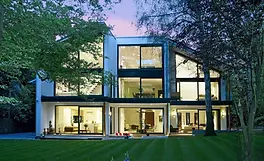
Option 2

Option 3
It is specifically designed for residential buildings (1–5 storeys) and is well suited to large-scale housing developments in different countries. All panels and structural elements are 100% factory-manufactured, delivered to the site, and assembled into a complete home within just a few weeks.
Homes built with fibre-cement SIP panels are highly durable, with seismic resistance of Grade 7–8, and comply with typhoon resistance Class 16 or 17. They are capable of lasting for centuries with minimal maintenance and without structural issues.

Modular “LEGO-Home” Expansion with Fibre-Cement Panels
Extension of the Second Module in LEGO Homes Using Fibre-Cement SIP Panels (50 m² Expansion)
The extension of a second module in our LEGO-style homes—adding an additional 50 m²—is an integral part of the original design, planned from the outset to allow seamless future expansion at the homeowner’s request.
This system enables the rapid casting of the second foundation section, engineered to carry the required structural loads. All service routes, including pipework and electrical conduits, are pre-positioned to align with the future extension.
The additional living module is then quickly assembled using fibre-cement SIP panels, forming an airtight and thermally efficient envelope.
Thanks to precise factory manufacturing and compatible joint geometry, the new module connects to the existing house with fully sealed, weather-tight joints, ensuring structural continuity and long-term performance.

Today, the construction of private homes and commercial buildings using SIP panels offers a range of advantages, perfectly tailored to the requirements of your projects. In addition to their visual appeal, the panels provide excellent thermal insulation, ensuring a comfortable and energy-efficient interior. Only under these conditions will we include a solar power station for FREE as part of the SEG Programme.
Monolithic Construction to Passive House Standard – Wall Insulation
Monolithic construction for Passive House combines the strength and durability of a solid concrete structure with the highest standards of energy efficiency. The walls are insulated using high-performance materials such as mineral wool, PIR, or XPS, with thicknesses designed to achieve excellent thermal resistance, typically reaching R-values of 15 m²·K/W or higher.
This insulation is integrated into the wall system to minimise thermal bridges and create a continuous, airtight envelope. The result is a home that maintains a stable indoor climate year-round, dramatically reducing heating and cooling needs while maximising comfort.
Monolithic Passive Houses offer superior structural stability, thermal performance, and longevity, making them an ideal choice for energy-conscious homeowners who value both comfort and durability.


Roof Construction with Fibre-Cement PU Panels in a Passive House

In a Passive House, roof insulation is just as critical as wall insulation, and fibre-cement SIP panels with a polyurethane (PU) core provide an exceptionally effective solution. These panels combine robust fibre-cement outer layers with a high-performance PU insulating core, enabling the roof to achieve or exceed the required thermal resistance — often R-15 m²·K/W or higher, depending on panel thickness.
When properly installed, fibre-cement PU roof panels minimise thermal bridges, delivering a continuous layer of insulation that prevents heat loss through the building’s upper envelope. Their inherent rigidity and airtightness help maintain a stable indoor climate year-round, significantly reducing heating and cooling demand while ensuring a comfortable, draft-free environment.
Thanks to their structural strength and moisture resistance, fibre-cement PU panels integrate seamlessly with airtight membranes, ventilation systems, and solar installations, enhancing both the energy performance and long-term durability of the Passive House roof.

Compare Traditional Concrete Construction vs. Modular Home (Passive House Standard)

Conclusion:
A modular house built to the Passive House standard is constructed 4–6 times faster, lasts just as long, yet provides significantly lower operating costs and greater environmental sustainability.

1. Traditional (Capital) Construction
Traditional construction is the classic approach to building a home using concrete, brick, and other conventional materials.
Advantages: high durability, long service life, and the ability to create fully customized architectural designs.
Disadvantages: long construction time — the building process can take up to 6 months, and finishing or renovationmay require an additional 3–6 months. Moreover, traditional construction often involves significant financial investment and complex permits.


2. Modular Construction
Modular homes are a modern alternative to traditional building technologies.
Advantages: fast assembly — from 2 to 4 months; no need for renovation after installation. Modules are often delivered with ready-made interior layouts, electrical wiring, and engineering systems, so all that remains is to connect the house to external utilities.
Disadvantages: limited options for fully custom architectural designs (depending on the manufacturer).
Modern modular homes are in no way inferior to traditional construction — they offer the same level of comfort, as well as excellent thermal and sound insulation, and visually can look identical to brick or concrete houses.
Passive House Modular Homes: Standards for Energy-Efficient Construction
Our modular homes are built according to the Passive House Standard, combining cutting-edge technology with sustainable materials to deliver exceptional comfort and minimal energy consumption.
1) Energy Efficiency
• Maximum heating energy demand: ≤ 15 kWh/m² per year
• Total primary energy consumption (heating, hot water, electricity): ≤ 120 kWh/m² per year
• Building airtightness (Blower Door Test): ≤ 0.6 ACH (air changes per hour) at 50 Pa
2) Structural Design and Thermal Insulation
Walls:
• Prefabricated high-performance insulated panels (timber or light steel frame with mineral wool, PIR, or XPS insulation, 250–350 mm thick)
• Wall U-value: ≤ 0.12–0.15 W/m²·K
Roof:
• Insulated roof structure with 300–400 mm of PIR or mineral wool
• Roof U-value: ≤ 0.10 W/m²·K
Floor / Foundation:
• Insulated floor slab with XPS insulation ≥ 300 mm
• Floor U-value: ≤ 0.15 W/m²·K
Windows and Doors:
• Triple-glazed units filled with argon or krypton, certified by the Passive House Institute (PHI)
• Window U-value: ≤ 0.80 W/m²·K; Solar transmittance (g-value) ≈ 0.5


A New Generation of Homes: The Look of Tradition, the Efficiency of Innovation
A Passive House modular home looks exactly like a traditional house built using conventional construction methods. However, its true advantage lies in the technology at its core: these homes offer exceptional energy efficiency, comfort, and durability. Thanks to precise factory assembly, superior insulation, and airtight design, modular homes maintain a stable indoor temperature all year round while minimizing heating and cooling costs. It’s a modern solution that combines the aesthetics of a classic home with the innovation of sustainable building.
We produce one model of a private home at GDB Passive House — but this home comes with a range of unique advantages!
A 250 m² home from GDB Passive House can be purchased through commercial leasing, with only 30% of the total cost required as an initial payment — available for any configuration level.
At the Premium / Passive House Level (USD 1,500 per m²), you receive a fully furnished, move-in-ready homedelivered within just 4 months from the date of advance payment!


Building the homes of tomorrow — today!

Innovations in Modular Home Construction
Innovative technology for building modular houses The construction utilizes multiple layers and concrete slabs, resulting in high strength and good insulation of heat and noise. On the outside, a diffusion membrane is placed on the frame, which allows vapor diffusion but prevents the passage of moisture. The wall is then sheathed with 12mm thick cement-bonded particleboard (CBC). The particleboard is an environmentally friendly material.
