
About Our Passive House Standard Homes

SEG ENERGY LEASING LIMITED develops and delivers next-generation private residential housing projects designed and constructed in full compliance with the international Passive House standard. Our homes are focused on extremely low energy consumption, a high level of living comfort, and long-term operational reliability.
The structural core of our buildings is based on SIP panels with cement-bonded particle boards (CBPB) and graphite-enhanced XPS insulation, providing:
-
excellent thermal insulation and the elimination of thermal bridges;
-
outstanding airtightness (n50 ≤ 0.6 h⁻¹);
-
non-combustible external envelope construction;
-
high resistance to moisture, frost, and demanding climatic conditions.
The houses are designed according to a modular “transformer house” concept, allowing the floor area to be expanded step by step without compromising thermal performance and without excessive upfront construction costs.
Our Projects are targeted at the EU and Caucasus markets and rely on materials fully compliant with EN standards, CE marking, and Passive House requirements, making the quality of SIP panels a critical component of the entire building system.

We install, Free of charge, a solar power system and a 22 kW MIDA (China) home charging station under a roof lease agreement of 15 years or more. This allows you to sell surplus energy back to us and receive cashback when charging your electric vehicle at GDB Green Energy Village homes or at Passive House–standard homes built on your own land under our Projects.

Panoramic Architecture and Precision Engineering at GDB Green Energy Village
In the homes of GDB Green Energy Village, the windows and doors are truly conceptual — stretching from floor to ceiling and visually expanding the living space.
Our equipment is supplied by companies from Poland, Latvia, Turkey, and China, all selected through a competitive process. These manufacturers produce the core components of their systems in-house, ensuring exceptional quality and technological consistency.


Why a Passive House Home is Superior to a Regular House?

Passive House Home, Even in Cold Weather...


სახლის დამტენი სადგური
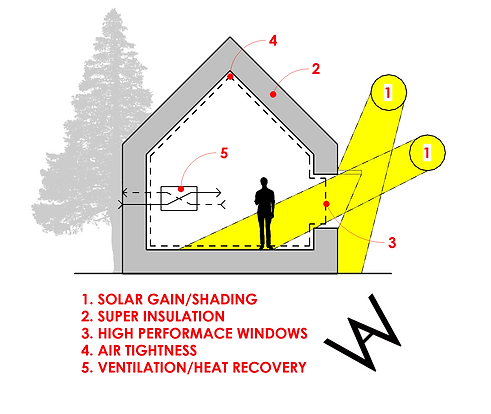
A Passive House is not just a well-insulated or airtight building. Unlike ordinary homes, it is a carefully engineered system that combines high-quality insulation, airtight construction, advanced windows, and high-performance doors to maintain comfort throughout the year.
1. No Need for Constant Heating
In winter, a Passive House retains heat extremely efficiently, meaning you do not need to constantly heat your home. The internal temperature remains comfortable even during the coldest months, drastically reducing energy consumption and heating bills.
2. No Need for Air Conditioning in Summer
During hot summer months, a Passive House stays cool without requiring active air conditioning. Its insulation and airtight design, combined with shading and ventilation strategies, prevent overheating and reduce electricity usage.
3. Advanced Window Technology
Passive House windows feature special triple-glazed units with inert gas fill and low-emissivity coatings. These glass units:
-
Minimise heat loss in winter
-
Limit heat gain in summer
-
Improve sound insulation
4. High-Performance Doors
Doors in a Passive House are also thermally insulated and airtight, preventing heat loss through entrances and contributing to the overall energy efficiency of the building.
5. A Holistic Energy-Saving System
The Passive House standard is a complete approach, not just a matter of insulation. Every component—walls, roof, windows, doors, and ventilation—is designed to work together. The result is a home that:
-
Keeps warmth inside in winter
-
Remains cool in summer
-
Minimises electricity consumption
-
Provides unmatched comfort and indoor air quality
In short, a Passive House saves energy, reduces utility costs, and ensures year-round comfort, far beyond what a conventional home can offer.

სახლის დამტენი სადგური
Optimising Window Placement and House Orientation for Comfort and Efficiency
სახლის დამტენი სადგური

სახლის დამტენი სადგური

Windows Used in GDB Green Energy Village Homes

სახლის დამტენი სადგური


Passive House Entrance Door in GDB Green Energy Village Homes
Recommended SIP-Panel Wall Thickness for Passive House Entrance Door

Notes:
-
SIP-panels consist of 12 mm cement-bonded particle board + graphite XPS insulation, providing high R-valuessuitable for Passive House standards.
-
Wall thickness ensures Uf (frame) and Uw (window/door) values meet Passive House energy requirements, with air tightness ≤ 0.6 ACH.
-
Glass inserts are triple-glazed, low-emissivity, with inert gas fill to maintain energy efficiency while maximising natural light.
-
Manufacturer's warehouse price: USD 50/ m2 (for Georgia/ Turkey).


Villa Entrance Door – Passive House Standard
The villa entrance door is an essential element, both in terms of security and aesthetics. You can add elegance to your home with durable and stylish villa doors, designed to combine beauty and functionality.
Villa Entrance Doors
Villa entrance doors are the first line of protection for your home. These doors, which catch the eye with their modern and stylish design, are made from strong and secure materials. They are engineered to meet both aesthetic and functional requirements, and when designed to Passive House standards, they also provide exceptional thermal insulation and airtightness, contributing to energy efficiency and comfort.
Villa Door Prices
Prices for villa doors typically range from USD 2,500, depending on the materials used, the security level, and the design. Passive House‑compliant doors may be at the higher end due to the specialised materials and insulation requirements.
Villa Door Models
Villa door models are carefully designed with both style and security in mind. Each model is crafted to complement the architectural style of the villa, while Passive House models ensure high energy efficiency, airtightness, and minimal heat loss, without compromising on elegance.
Black
Wood
Combined

Passive House Doors in GDB Green Energy Village Homes
Interior Doors and Ventilation in a Passive House Home
Doors and windows are an essential part of a Passive House design. The U‑value of doors should not exceed 0.8 W/(m²K) at the component level. In building our homes, we are committed to doing everything possible to address the climate crisis, and we have developed a range of doors certified to the Passive House standard.
These doors include fully glazed doors, solid doors, and doors with visual panels. Where required, glazed side panelscan also be incorporated to enhance light and aesthetics without compromising energy performance.
Manufacturer's warehouse price: from USD 900 (price in your home).


Passive House Supply and exhaust ventilation in GDB Green Energy Village Homes
Interior Doors and Ventilation in a Passive House Home
Mechanical Ventilation – Supplied with Every Home Kit
Every Passive House home kit comes equipped with a state-of-the-art mechanical ventilation system with heat recovery. This system continuously provides fresh, filtered air to every room while recovering up to 90% of the heatfrom outgoing air in winter. In summer, the system helps prevent overheating by pre-cooling incoming air and maintaining a healthy, comfortable indoor climate throughout the year.
Together, the airtight interior doors and mechanical ventilation system ensure that the home remains energy-efficient, comfortable, and healthy, providing superior indoor air quality compared to conventional homes.
Manufacturer's warehouse price: from USD 4,500/ 50 m2 (USD 90/ m2) (price in your home).


Add Innovation and Extra Natural Light to Your Home with Solatube Skylights
To ensure that your second open floor receives more natural light, all our homes are equipped with the innovative British Solatube skylight. These solutions capture sunlight from the roof and efficiently channel it into your home, providing natural, evenly distributed light even in rooms without traditional windows. Cost including installation on the roof of your home: from GBP 1,000 to GBP 2,000, depending on the required capacity.


Our Business Partners and Suppliers


